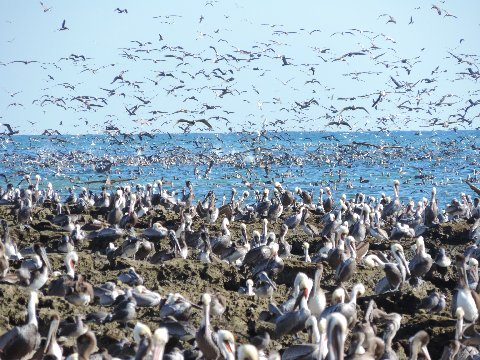
I've been making a sort of informal observational study of Pelican behavior along the beach and am wondring if anyone can add something.
It's fun to watch a slipstreaming line go by. Watch the lead bird and count how many times it flaps between glides. I've been coming up with the magic number 7 + or - 4, a magical number to research psychologists since it appears in so many different contexts. The flapping works it's way back the line, with 2 or 3 adjoining birds flapping until they reach the magic number. Often the entire line is gliding for a short time until the lead bird loses altitude and starts the process over again. The entire line undulates like a snake gaining altitude while flapping then the slow decline while gliding. All in all a lovely dance of nature.
Watching them feeding is fun too. If there is a lot of feed available, they simply float along in groups and gobble down what they catch by poking their heads under water. Often they will fly to gain some altitude, seems like just about enough to permit the bird to attain a verticle posture during the fall to the sea. They don' t seem to extend their long necks during the dive which surprised me at first. When the beak enters the water it seems to be on a line above and parallel to the line of the body of the bird. The neck is crooked at entry to the water as it appears to exit the skull at about a 45 degree angle from the long beak. The wings are partially extended at entry too, not streamlined back along the body as one might expect during a dive. Might absorbe some of the force of entry into the water so as not to break the already crooked neck.
When they catch something they seem to hold their head and beak under water for some time and they wiggle their tail feathers. Interesting. Must be counterbalancing some movement under water. Maybe movements made to get the catch firmly into the pouch as I seldom observed any silver at the beak when the head comes out of the water. Based on the movements of the head after it comes out of the water I would guess it is working the fish out of the pouch and into the throat at that point. You can see how this underwater routine is useful as virtually every time I observed a pelican dive one or two smaller sea birds immediately fly to the diver and hover around, and peck the pelican's head as if they are trying to force a mistake so they can snag the fish.
I wonder if the pelican actually spears the fish or scoops it into the pouch. From what I can observe the beak is opened at entry to the water, but only slightly. Must be an awful squirt of water into the pouch and neck that has to be controlled some how or the bird would qickley choke, wouldn't you think.
Anyone know how to tell a male from a female? Is there a typical reproductive time of the year? Can't say I can recall seeing what I would call immature birds based on size.
You'll also notice that when there is a string of 4 or 5 of them "buzzing" the water line, they all flap their wings in the same place. (not at the same time) Watch where the lead bird flaps his wings and all the followers will flap at the same place when they get to it.
Very observant Roberto, however do you know why one side is longer than the other?
Good question Inks, I have often noticed that... But, why is that when you sea pelicans flying in a V formation one side of that V is always longer than the other???
The length of either side of the V is random. Whether it is a V formation or straight formation is of no particular importance as long as one bird is behind the other to gain the slipstream lift advantage. The lead bird will also switch out periodically when tired.
I have been wondering how a flying line of pelicans is formed. Do they always fly together, perhaps a genetically related family? Do they stick together all the time or is the formation of the group more flexible?
There was a huge Feed last night just west of Mannys, upwards of 50 birds. I noted several groups flying along the Playa and over the feeding activity that some of the flock would continue and fly on past the feeding frenzy, but some would peel off the line and dive for grub. That would argue for the possibility that the formation of the group is random, birds joining flocks more or less arbitrarily or based on intended activity and not familial ties. Of course I guess they could gather again back at home base, if there is one. There's another question. Do they tend to overnight in the same location each night?
I noted last night that the birds who flew up from the feeding area to prepare for a dive tended to fly low and with the prevaling wind, turn then fly back over the feeding area into the wind gaining altitude for the dive. Don't pilots of airplanes like to take off into the wind? I seem to recall they get increased lift that way.
Last night there was a smallish group of about 15 birds feeding together, very close to the beach in what should be shallow water. I would think that they were stabbing into the bottom on a dive. The pesty little dark birds out numbered the Pelicans by 2 or 3 to one. This group seemed to coordinate dives. Four or 5 birds would take off together, up then dive. Immediately they were mobbed by the pesky birds.
You have to have just the right angle to view it, but they seem to qucikly extend that long neck right at the point of impact with the water, stabbing into the water at the last instant. Probably an adjustment for the final location of the prey, otherwise the entire glide would have to be lined up perfectly on the target. This also make me think that what they look for and see when flying and gliding is a school of fish rather than an individual fish. Glide and dive into the school and pick one out of the crowd at the last instant. Make more sense than a long glide at an individual target, like shooting an arrow.
On the stabbing or scooping question I'm thinkin scooping because if you look closely at the end of their beak, there is a hook that is pointed almost perpendicular to the line of the long beak effectively making the tip of the beak round and not pointed. The hook would be effective in snagging a fish but not stabbing.
Since they were close in they were fishin pretty much in the band where the surf breaks. They don't seem to be much bothered by the surf. I watched for an hour and only on one occasion did a wave break over a pelican a little bit. This one just rolled a bit and swam right over. Mostly they fly up and over an oncoming breaking wave, or glide over the wave between the breaking portions of the wave. They appear to be able to sense a breaking wave coming. Perhaps vibration in the water or probably sound. However they do it, they do it with great skill.
Last night I observed another bird fishin with the Pelicans. These were small white birds with a black head and some black on the wingtips. The wings were shaped more like a swallow, thin and ponted and they really didn't glide much at all. They also didn't really dive, but rather would fly across the surface and sort of dip into the water. When the pelicans left they did too.
I noticed that the pelicans would keep their beaks under water for a time after stabbing....probably emptying out any water. They they would raise their heads...and you could see them swallowing...that whole "pouch" was moving. I also noticed some other little gulls trying to steal the fish after they stabbed the water....
These were small white birds with a black head and some black on the wingtips. The wings were shaped more like a swallow, thin and ponted and they really didn't glide much at all. They also didn't really dive, but rather would fly across the surface and sort of dip into the water.
That sonds like a Tern http://en.wikipedia.org/wiki/Tern except most of those little jet plane's dive in hard and fast.. Their all over, both fresh and salt, and man can they haul!
Definately look like a Tern, except they are described as medium to large birds and these were about the size of maybe a Robin. Wings are very similar. The little guys I watched did not really do a showy dive like the pelicans. They more like seemed to slow and poke their beak into the water.
Oh they have "little guy" Turn's too, but I've never seen one feed like that, though some may.
The Tern is a bird that spends most of its days at sea forging for food. While they vary in appearance, the many varieties of Terns are all water loving birds who eat mostly fish. They soar through the sky and dip down to the water's surface for fish.Read more:http://www.ehow.com/how_2063542_identify-tern-bird.html.
Just kidding! I thought I was the only one obsessed with these flight patterns while on the beach. They're fascinating to watch and just about my favorite way to zone out while staring out at the ocean...But yeah, I never think to research it when I get home. Thanks for the post!
Just kidding! I thought I was the only one obsessed with these flight patterns while on the beach. They're fascinating to watch and just about my favorite way to zone out while staring out at the ocean...But yeah, I never think to research it when I get home. Thanks for the post!
There are always things to entertain oneself, but it seems that the entertainment required by humans must have a high sensory input to be called entertainment. TV, movies, radio, loud and raucous. People have not learned to entertain themselves with simple things. Read or re read Walden Pond.
Personally I do not understand the increading trend of violence, blood and gore that has occured in the Movies and TV over the years. In my life, I have seen and experienced enought terrifying things first hand, I don't need vicarious terror.
Why in the world would I want to PAY someone to terrify me when I get that for free !!
I also observe the ants crawling on the bougainville outside my bathroom window, but they don't do much other that march ahead in a continuous stream, up and down the vine.
Back in the mid 90's there was something that killed off a lot of pelicans.....all along sandy beach....it was sad to see the birds just sitting there waiting to die....in the summer sun....we even tried to give them some water...but no go....
One evening I observed a lone pelican roosting on my roof, with a length of what appeared to be fishing monofilament hanging from its beak. Apparently, it had ingested something harmful. I obtained a ladder, and it allowed me to approach closely, but ultimately flew away. I was quite sad, and frequently wonder about the fate of this bird.
Watching the pelicans dive at the Malecon yesterday. One thing I had not noticed before is that after diving and capturing a fish and while the little pesky moocher birds hover close to the pelican's beak (bill?), the pelican makes a very rapid turn around, spin, in the water immediately, turing its back on the moochers, before putting it's beak up, opening a bit and swallowing the fish. Seemed clearly a learned response to protect their catch from the pesky moocher birds.
Did you notice the "teenager" pelicans flying behind the larger pelicans this past weekend? There must be a lot of fish out there w/ all the pelican activity.
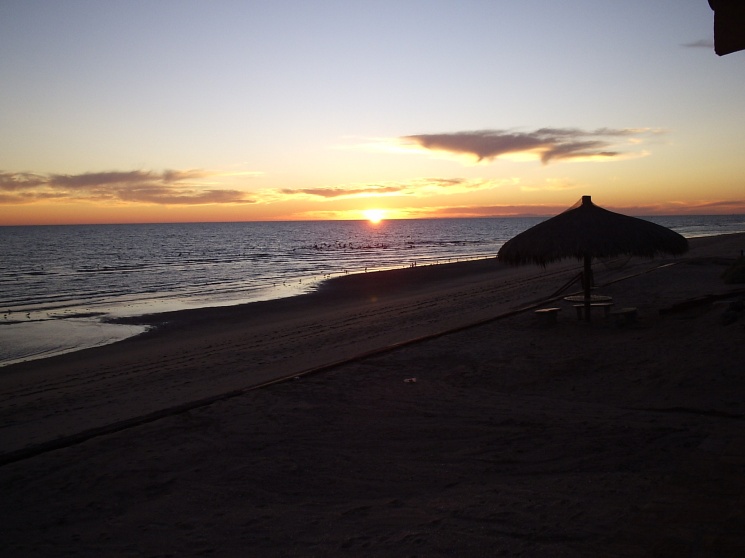
Last evening as I was enjoying an adult beverage on the patio, I noticed a great number of pelicans feeding. If you look closely at the picture
you will see some of them just below the sunset.
I also noticed what Roberto called a huge number of moocher birds hanging around. This led me to wonder:
Why are there many more moochers than workers? The worker birds fly up, dive into the water and catch their dinner.
The moochers fly right in and try to take the bounty from the hard workers.
Why do the worker birds try to keep their bounty from the non-worker birds? Obviously they don't understand the new bird order.
Where have I seen this before?