This is some of the best news yet in the effort to stop the destruction of the fish and wildlife in the Sea of Cortez. I just hope they are serious about implementing their "new plan" as well as enforcing it...with serious consequences. They also need to include long line fishing bans and restrictions to the shrimp trawlers in their plans. The article says the governors of Sinaloa, Nayarit and Baja California were present, but not the governor of Sonora?? Not a good indication of local support. The following quote is a long overdue response to the problem but unfortunately may be too late. The threat to the Vaquita “is a symptom of a broken system,” said Alejandro Robles, chairman of the Mexican environmental group Noroeste Sustentable. “The Upper Gulf has tremendously valuable resources. It has been the historical disorganization of the fishing sector that has created what we have today.”
The extent of the damage already done is sad and overwhelming. http://www.seawatch.org/reports/sea_of_cortez.php
It will never happen, since once they are all gone they won't be a problem any longer.
Hit the beach at Santo Tomas last Saturday afternoon. Made a right turn, went 100 feet and saw a dead sea turtle in the surf. It was an adult Olive Ridley with no obvious injuries. Went another 200 feet saw two dead sea turtles in the surf. They were one adult and one juvenile about two feet long Olive Ridley's with do obvious injuries. We started a tally sheet then stopped counting dead sea turtles at two miles of driving with eleven dead. At our turn around point we estimated at least one dead turtle every quarter mile. We drove about twenty miles up the beach that day, which means at least eighty dead turtles. We did not count the dead Sea Lions or Dolphins, but there were plenty. No animal of that size and lifespan can withstand losses of breeding adults at that level. I believe those turtles had all drowned in gill nets and trawl nets.
Think you are right but when they come by the dead stuff on the beach is eveywhere.Like Jim reported the dead Sealife count by us is just unreal....maybe a red tide? Maybe they are just starving?
In late January I wrote: " I saw last weekend what looked like a red tide, but then it went away with the higher waves. I say red tide because the sea was so blue, but the dark area looked more reddish in color. Also there were more dead birds (mostly small) on shore. "
We've spent the last few months cleaning up the dead birds and sea lions on our beach, and I would guess it's from the algae in January/February/March. The only time I could visibly see it was in late January, but the health dept testing could still spot it through March.
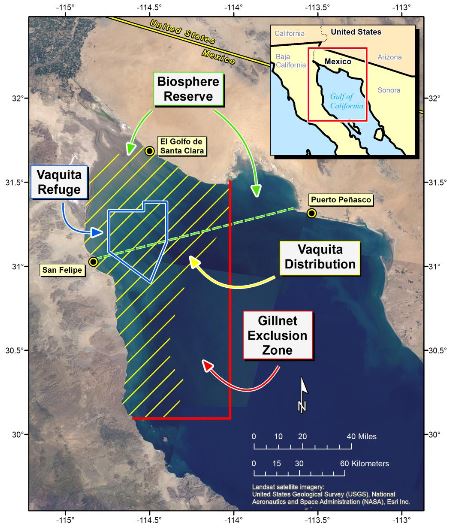
How does the ban affect RP pangeros? The exclusion zone is on the western half of the upper Sea of Cortez, nowhere near RP. The local pangeros shouldn't be subsidized because they aren't being restricted. Or am I missing something?
How does the ban affect RP pangeros? The exclusion zone is on the western half of the upper Sea of Cortez, nowhere near RP. The local pangeros shouldn't be subsidized because they aren't being restricted. Or am I missing something?
Gill net ban expected to impact local panga operators
By Azucena Mazon on April 17, 2015@rockypoint360
At least 350 panga operators and some 1,000 families in Puerto Peñasco will be affected by the temporary ban on gill nets for smaller boats, known as “pangas”, in the northern part of the Gulf of California in an effort to protect the endangered vaquita marina and other species.
On April 10th, the Official Journal of the Federation published notice of the two year ban for the Upper Gulf of California, which encompasses fleets of smaller vessels in Puerto Peñasco, the Golfo de Santa Clara and San Felipe. Within the area of Puerto Peñasco alone there are 350 permit holders that will be directly impacted by this ban, and at least 1000 additional families that are part of the productive process.
The temporary ban launched by the Secretary of the Environment and Natural Resources (SEMARNAT) regarding commercial fishing through the use of gill nets was planned as a measure to protect the endangered vaquita marina, a species endemic to the area of which studies show there to exist approximately 100 in the Upper Gulf.
Hermenegildo Ramírez López, Director of the Fishing Office in Puerto Peñasco, indicated one of the factors that will most heavily impact panga operators in Puerto Peñasco in particular is the fact they were not included within a compensation program of up to 1 million pesos being applied to permit holders affected by the fishing ban. In addition, he expressed, there is a serious problem of uncontrolled clandestine fishing, which in Puerto Peñasco points to at least more than 500 pangas operating outside of the law.